Wisdom shines on the Danube River
-----Qingdao Eversafe Romania airbag bravely rescued the "waterless boat"
Due to the lack of time, the shipowner asked Eversafe Company to first issue a technical plan and go to the site directly if the plan was feasible. Eversafe company was in a dilemma. Without on-site investigation and the incomplete data provided by the other party, how could we take over this job?
Wisdom 1. Find Strategy Far Away , Technology is the Key
Time was of the essence, and both Eversafe and the shipyard began to operate at high speed. The shipyard measured various data on-site and conducted underwater surveys and mapping according to our requirements, and then promptly sent the materials to our company. After thorough calculations and simulations, we developed three airbag salvage plans for the shipowner to consider and choose from. Since the airbag project had no precedent in Europe, the shipowner and the shipyard raised many questions about the plans. Our company addressed these concerns by providing detailed drawings and calculations that explained the pros and cons of each plan. Ultimately, Eversafe's rigorous approach and scientific attitude reassured the shipowner, who signed the contract with us within a week and prepaid 100% of the contract amount. Through this interaction, we gained a deep appreciation for the shipowner's meticulous and efficient work ethic.
Wisdom 2: One Hammer down on the Danube
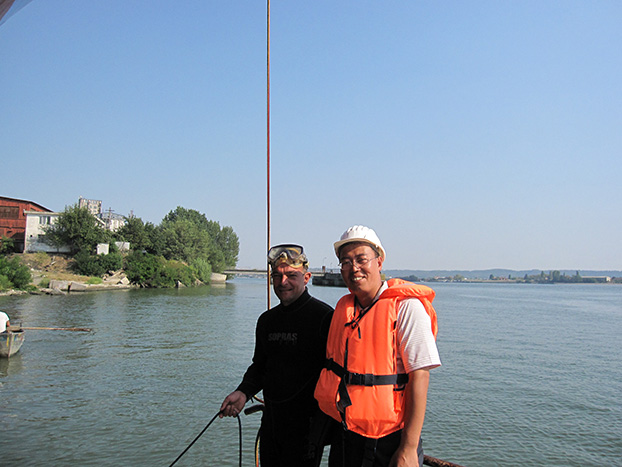
Three days after the contract was signed, two engineers from Eversafe flew 14 hours to Turnu Severin, a border city in Romania. It is just 1km away from Serbia across the Danube river.
Without time to see the exotic scenery or rest, the engineers left their luggage and rushed to the shipyard. In August, the temperature in the afternoon in Romania reached 45 degrees Celsius. After two hours of on-site investigation, the engineers were in a heavy mood.
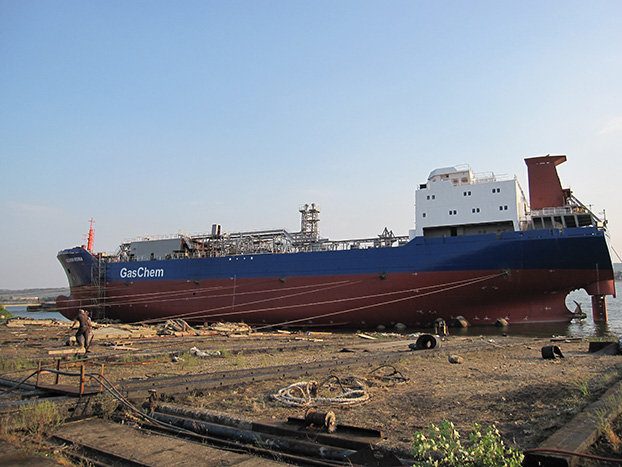
The shipyard, built with Soviet aid in the 1950s, has traditionally used a wooden slipway for launching ships. Due to poor maintenance of the slipway, when launching the 6,500 cubic meter liquefied gas vessel, most of the slipway and pulley broke, causing the hull to run aground on the slipway at a depth of 1.5 meters. The ship was found with a longitudinal inclination of 9.8 degrees and a transverse inclination of 9 degrees, with the condition of the bottom remaining unknown.
The shipyard, the shipowner, and our engineers engaged in technical discussions. The shipyard hopes that after the airbag rises to lift the accident vessel, they can repair the pulley and continue using it for launching the vessel. However, the shipowner is skeptical about this approach and also has doubts about whether the airbag will successfully enable the vessel to be launched.
We suggest holding a meeting on site. In view of the shipyard's suggestion to continue using the trolley, we ask the diver to go down to investigate the water slide: if the slide is in good condition, then using the trolley to go down to the water will be beneficial for both sides: we only need to lift the ship and clean up the broken trolley.
However, the divers' inspection and photographs revealed that at least four underwater slides were no longer usable, creating a tense atmosphere on site. Despite this, the shipyard insisted on lowering the pulley into the water and suggested replacing some of the underwater slides. The shipowner and our team held private discussions, and we concluded that lowering the pulley posed significant risks, while the airbag solution was more practical and feasible.
Finally, the shipowner decided to use the plan of lifting the airbag and launching the ship, and asked us to take full responsibility for the on-site command.
Wisdom 3: Persistence and Cooperation
We began to supplement, revise and decompose the salvage plan overnight, and made detailed explanations of each step. The next day, a technical briefing meeting was held on site, and each commander had a technical plan.
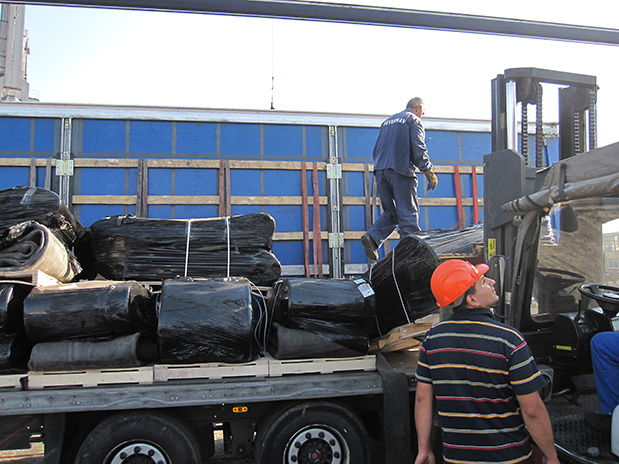
The airbags transported by air have arrived at the site, and according to the plan, people began to place them. The condition of the ship's bottom is complex, with some parts on the slide and others on the trolley, and there is 1-2 meters of water. Due to the lack of operational experience among the workers, the placement of the airbags has been slow. The distance between the ship's bottom and the underwater ground is as little as 30 centimeters, making it impossible for divers to enter the ship's bottom to assist with the work, which further complicates the task.
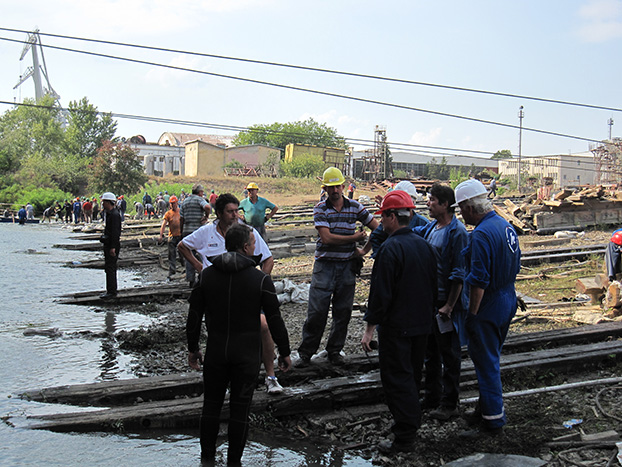
On that day, the shipyard invited a top engineer from Romania's shipbuilding industry to review and supervise our technical proposal on-site. We referred to this engineer as the' old master,' who raised many critical questions about our proposal. We had to prove the feasibility and safety of the proposal from a theoretical standpoint and address various on-site challenges, which left us extremely exhausted.
On the third day, 10 airbags were precisely positioned and inflated, and the bow of the boat was slowly raised. Seeing that the project had made good progress, the staff on site were shocked and removed the broken pulley under the bow in one go.
On the seventh day, 26 airbags fully lifted the hull and the pulley was cleaned up.
At this point, the ship's transverse inclination angle had returned to about 7 degrees, which closely matched the calculation results we provided. Previously, the old master believed that after the ship was lifted by the airbags, it might slide sideways. Despite our data showing that such a sliding would be impossible, the shipyard insisted on adding lateral steel cables. After the ship was lifted, the transverse inclination angle actually decreased, and the lateral steel cables showed no tension. Before the ship was launched, all the lateral steel cables were removed. Since then, the shipyard and shipowner have shown unprecedented confidence in our company.
It was a memorable day. At 7 PM on the evening of February 2, 2011, the Danube River was quiet again and people were eagerly awaiting the exciting moment of entering the water.
The ship's stern was slowly being pulled, but the large vessel remained motionless. The surroundings were silent, with only the sound of water and anxious chatter from the walkie-talkies. After three minutes, the ship had moved forward about 2 meters. The on-site command personnel coordinated the towing tug and trailer to work together, and by the fifth minute, people could already feel the movement of the ship. Whispered conversations filled the air, mingled with a mix of suppressed excitement and fear. The large vessel seemed to awaken like a whale, slowly stretching out. By the sixth minute, the stern had reached the water's surface. As the ship gradually rose, airbags emerged one after another from the bottom of the hull. The 18-meter-long marine airbags roared out and slammed heavily onto the water. The crowd around began to erupt in cheers, each leap of an airbag accompanied by excited shouts: Flying fish! Flying fish! Ten minutes later, the ship smoothly entered the water and was fully afloat.
The old master was the first to come and hug us, followed by the shipowner and the manager of the shipyard. People kept coming to shake hands and congratulate us. The beautiful Danube river was jubilant in the sunset.